
The DevOps Geneva Meetup once again delivered on its promise with an evening packed with technical discussions, fresh insights and genuine human connections. On Thursday, February 8, 2024, the Geneva DevOps community gathered to share knowledge, learn from each other and build relationships around the topics that matter most to today's engineering teams.
A growing community
At 18:00, the doors opened to a room already buzzing with energy. Developers, infrastructure engineers, cloud architects and IT managers took their seats, ready to discover the evening's two talks. What makes these meetups so valuable is the diversity of attendees. You'll find curious juniors alongside seasoned veterans, freelancers alongside employees from major Swiss companies.
The DevOps Geneva Meetup has been steadily growing since its inception. Each edition draws more attendees than the last, reflecting the maturation of the DevOps ecosystem in the Lake Geneva region. What started as a small gathering of enthusiasts has become a reference event for the local tech community. The group now counts hundreds of members on Meetup.com, with regular attendance of 50 to 80 professionals per evening.
This growth mirrors a broader trend across Switzerland. As companies accelerate their digital transformations, the demand for DevOps skills has surged. According to recent industry data, DevOps-related job postings in Switzerland have increased by over 40% in the past two years, with Geneva and Zurich leading the way. Community events like this one serve as an essential bridge between formal education and the practical knowledge that teams need on the ground.
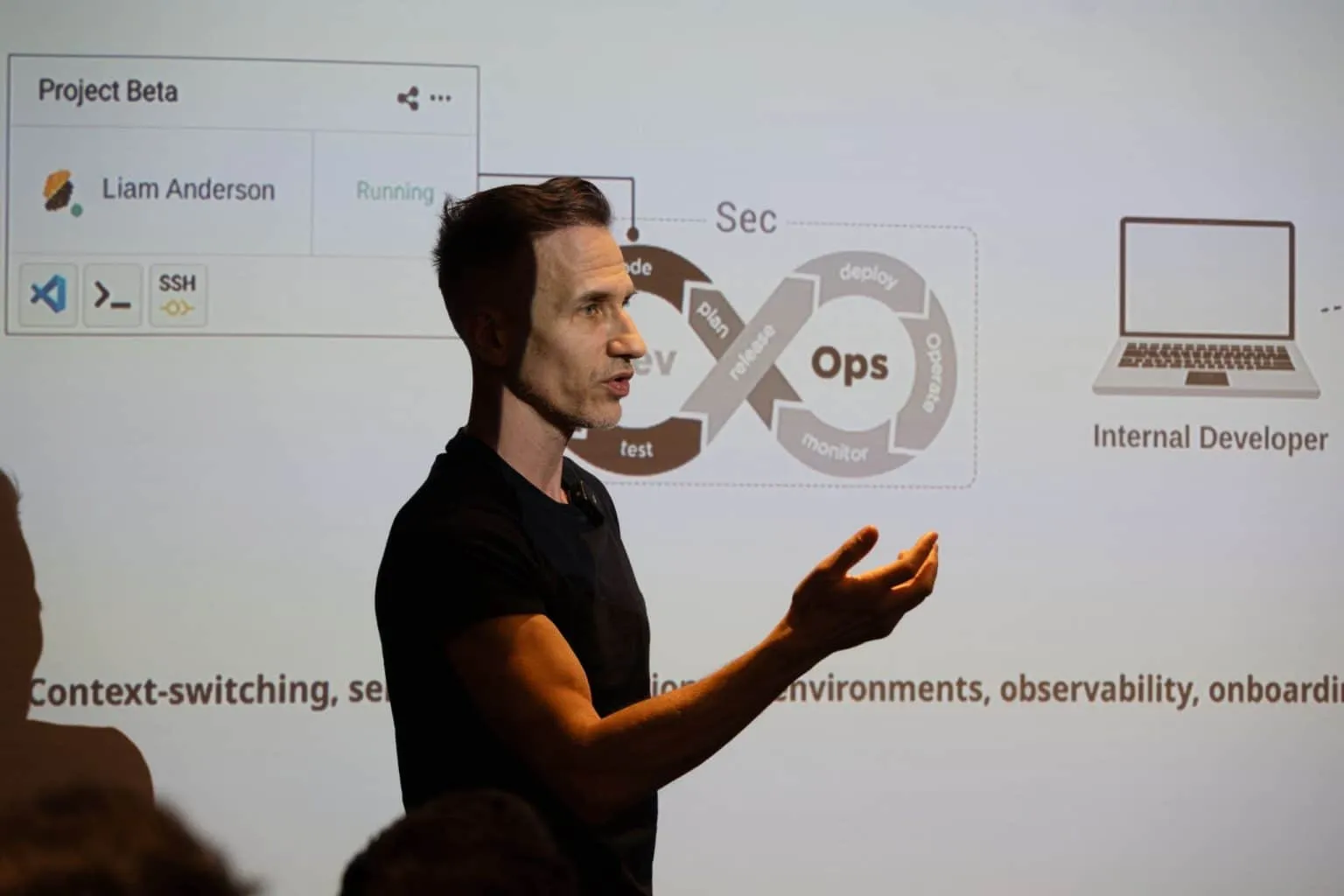
The DevOps process by Laurent Balmelli (Strong Network)
The first presentation of the evening was given by Laurent Balmelli from Strong Network. His talk focused on the fundamentals of the DevOps process, and specifically on the three principles that underpin modern application development: flow, feedback and continuous learning.
Laurent demonstrated how these principles, far from being purely theoretical concepts, translate into concrete daily practices for development teams. He explored the role of Cloud Development Environments (CDEs), which add a dimension of immediacy to DevOps workflows.
CDEs allow developers to spin up a complete environment in seconds, without complex local configuration. This saves considerable time, but it also improves the feedback loop: when a developer can test changes in an environment identical to production within moments, development cycles naturally accelerate.
One particularly compelling point Laurent raised was around the concept of "environment drift." In traditional setups, a developer's local machine gradually diverges from production over time: different library versions, OS-level patches, configuration nuances. CDEs eliminate this drift entirely because every environment is ephemeral and provisioned from the same declarative specification. For organizations running regulated workloads (banking, healthcare, government), this consistency is not just convenient, it is a compliance requirement.
Laurent also emphasized continuous learning as an often-neglected pillar of DevOps culture. Post-mortems, retrospectives, cross-team knowledge sharing: these are all practices that transform incidents into improvement opportunities. This is precisely the spirit of these meetups, where every attendee leaves with new ideas to experiment with.
A key takeaway from Laurent's talk that resonated with several attendees during the Q&A was the measurable impact of CDEs on developer onboarding. He shared that teams adopting CDEs at Strong Network reduced new developer onboarding time from an average of two days to under two hours. For Swiss companies competing for scarce engineering talent, this is a significant advantage: a faster path to productivity means new hires contribute value sooner, and the reduced friction improves retention during the critical first weeks.
Container security by Bertrand Thomas (SUSE)
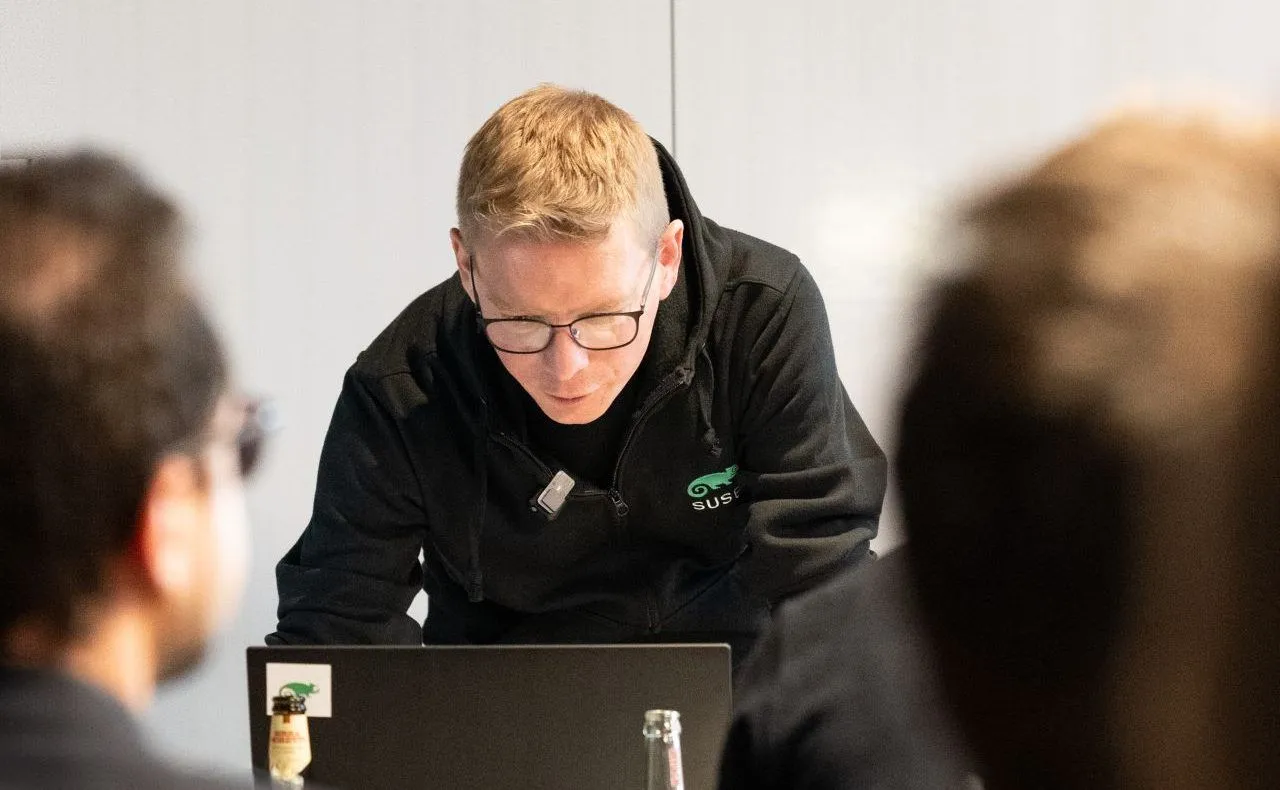
The second talk was delivered by Bertrand Thomas from SUSE, on a topic that concerns an increasing number of organizations: container security. His core message? Securing containers doesn't have to be complex, restrictive or expensive.
Bertrand presented a fully open-source solution capable of covering the various attack surfaces associated with containerized environments. From image building to runtime, through the registry and orchestrator, every stage in a container's lifecycle represents a potential attack vector.
What particularly caught the audience's attention was the demonstration that it's possible to achieve a high level of security without sacrificing agility or budget. In a context where Swiss companies are massively adopting containers and Kubernetes, this pragmatic approach to security resonates strongly with on-the-ground realities.
Bertrand walked the audience through several concrete attack scenarios. He showed how a misconfigured container with excessive privileges could allow lateral movement within a Kubernetes cluster, granting an attacker access to secrets, databases and other services. He then demonstrated how network policies, Pod Security Standards and runtime behavioural analysis could detect and block these movements in real time.
The Q&A session after this talk was particularly lively. Several attendees asked about integrating container scanning into existing CI/CD pipelines. Bertrand recommended a "shift-left" approach: scanning images during the build phase rather than waiting until deployment. This means vulnerabilities are caught before they ever reach a production registry. He also emphasized that the most common container security issues are not sophisticated zero-day exploits but rather basic misconfigurations: running as root, exposing unnecessary ports, using outdated base images with known CVEs.
Container security is a central concern for any company migrating to the cloud. At Hidora, we support our clients through this journey with our managed services and DevOps consulting.
Why DevOps meetups matter for the Geneva ecosystem
Geneva holds a unique position in the Swiss technology landscape. The city is home to a significant number of financial institutions, international organizations and tech startups, all facing challenges around infrastructure, security and regulatory compliance. In this context, DevOps meetups play an essential role: they allow professionals from these different sectors to share concrete, real-world feedback beyond vendor marketing narratives.
An engineer from a private bank who has implemented a CI/CD pipeline compliant with FINMA requirements can inspire a healthtech startup facing similar compliance challenges. A cloud architect from an international organization can share the specific challenges of multi-region deployment with data sovereignty constraints. These cross-sector exchanges are rare through normal professional channels, and that is what makes these evenings so valuable.
The Geneva tech ecosystem also benefits from the city's international character. Professionals from dozens of nationalities attend these meetups, bringing perspectives shaped by different engineering cultures. A developer who previously worked at a Berlin startup approaches problems differently from an engineer who built their career inside a Swiss private bank. This diversity of perspectives is a genuine competitive advantage for Geneva-based companies looking to attract and retain top technical talent.
Key topics shaping the Geneva DevOps conversation
Several recurring themes emerged during the informal discussions that evening, reflecting the priorities of Geneva's technical community right now:
- Kubernetes maturity. Many organizations have completed their initial Kubernetes adoption and are now focused on day-2 operations: monitoring, cost optimization, multi-tenancy and disaster recovery.
- Platform engineering. Teams are moving beyond ad-hoc tooling toward building internal developer platforms that standardize deployments and reduce cognitive load for developers.
- Observability beyond logging. There is growing interest in distributed tracing and OpenTelemetry as organizations realize that logs alone are insufficient for debugging complex microservices architectures.
- Regulatory pressure. The new Swiss Federal Act on Data Protection (nLPD) and increasing scrutiny from FINMA are pushing engineering teams to think about compliance as a first-class concern in their CI/CD pipelines, not an afterthought.
These themes align closely with the challenges we see our clients face at Hidora. The fact that they surface organically in community discussions confirms that they are not vendor-driven narratives but real pain points felt by engineering teams.
Networking: the other added value
The evening wrapped up with a relaxed aperitif, giving attendees the chance to continue discussions informally. It's often during these moments that the most interesting collaborations take shape. A developer looking for advice on a Kubernetes migration chats with an SRE who has lived through the exact same situation. A CTO weighing different monitoring solutions gets direct peer feedback.
Several conversations that evening touched on a shared frustration: the difficulty of hiring experienced DevOps and platform engineers in the Geneva market. Attendees noted that community events like this one serve a dual purpose. Beyond knowledge sharing, they function as an informal talent network where companies discover potential collaborators, and engineers discover opportunities that never appear on job boards. One attendee mentioned that their last two hires came through connections made at previous DevOps Geneva Meetup editions.
The collaborative spirit of the DevOps Geneva Meetup community is truly inspiring. By meeting regularly, sharing knowledge and supporting one another, attendees demonstrate that collective effort can lead to remarkable achievements in the DevOps field.
About DevOps Geneva Meetup
DevOps is far more than a set of technical practices. It's a cultural movement that transforms how organizations build and deliver applications and services. The DevOps Geneva Meetup is dedicated to fostering this shift by providing a platform where professionals can learn, share experiences and collaborate on innovative solutions.
Whether you're a seasoned professional or simply curious about the Geneva DevOps ecosystem, these events are open to everyone. Upcoming meetups will cover the latest trends, best practices and emerging technologies in the world of DevOps.
Hidora is proud to support this community and actively participate in Geneva's tech ecosystem. If you'd like to learn more about our cloud hosting solutions and DevOps services, check out our consulting offerings or managed services.

CEO & Co-founder
Founder of Hidora, passionate about cloud-native and Swiss digital sovereignty. 15+ years in the cloud ecosystem.