
Cloud hosting is a necessity for almost every business today. But the diversity of platforms can make it difficult to choose the right solution, especially when you're launching your first startup. We sat down with Jefferson Notaro, CEO and founder of Functional Box, to discuss his journey and his migration from AWS to Hidora.

Jefferson's background
Jefferson Notaro is an entrepreneur of Brazilian origin, based in Europe. His background combines systems administration and technical development, with education in computer engineering and economics. He began his professional career in 1985, with a primary interest in commerce and mutually beneficial exchange.
The birth of Functional Box
The story of Functional Box began in 2017. Jefferson was trying to organize his time and space for one of his passions, fitness. He built a small gym at home, his own crossfit "home box." But questions quickly arose: how do you stay motivated alone? How do you plan your workouts? How do you manage your nutrition?
From these personal questions, a product idea was born. Functional Box is a platform that connects fitness enthusiasts with wellness professionals, offering workout planning features, nutritional management and a subscription system that lets professionals sell their services.
The initial technical choice
As a Python developer since 2003, Jefferson naturally gravitated toward the Python ecosystem. His tech stack is built on Django, REST and PostgreSQL. Modules, middleware and networking are well handled by Django as well as FastAPI, but Python/Django remains the core technology. The Celery module plays an important role in the background subscription system.
The AWS experience: lessons learned
The first deployment was on AWS. It's a common choice for startups, almost a reflex in the industry. AWS is an excellent platform with many options. But for a startup in its early stages, the reality is more nuanced.
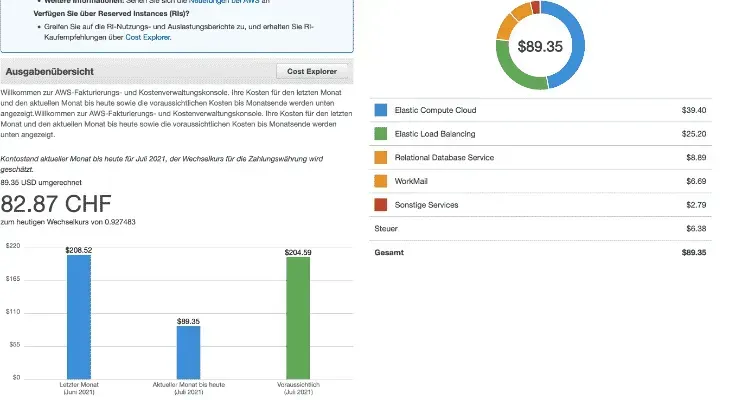
The main problem? Cost. Even with no traffic and no users, the monthly bill was substantial. For just a few weeks. When you're a pre-revenue startup, every franc counts. Paying that much every month to host an application that nobody is using yet is a significant budget that could be better invested elsewhere.
Jefferson acknowledges that AWS is often chosen as a trend. Job descriptions systematically require AWS skills, which pushes technical founders to adopt it by default. But it's not always the best fit for a young company.
The hidden complexity problem
Beyond the billing surprise, Jefferson encountered another challenge that many startup founders underestimate: operational complexity. AWS offers over 200 services, and even a simple web application deployment involves decisions about VPCs, security groups, IAM roles, load balancers, certificate managers and logging configurations. Each of these services has its own pricing model, its own documentation and its own gotchas.
For a solo founder or a two-person technical team, this complexity is a distraction. Every hour spent debugging an IAM permission error or understanding why a security group is blocking traffic between services is an hour not spent on the product. Jefferson estimated that during his first three months on AWS, he spent roughly 30% of his development time on infrastructure tasks that had nothing to do with Functional Box's core features.
This is a pattern we see repeatedly at Hidora when working with early-stage startups. The hyperscaler model is built for organizations with dedicated platform teams. When that team doesn't exist, the cognitive burden falls on the same developers who are trying to build the product.
The migration to Hidora

Jefferson looked for a Swiss hosting provider and discovered Hidora. The platform turned out to be even better than he had imagined. With the Jelastic system, he only pays for actual consumption, while being supported by real professionals.
The migration was carried out in close coordination with Hidora's technical team. After a meeting to discuss the main migration points, Jefferson received clear guidance on how to proceed.
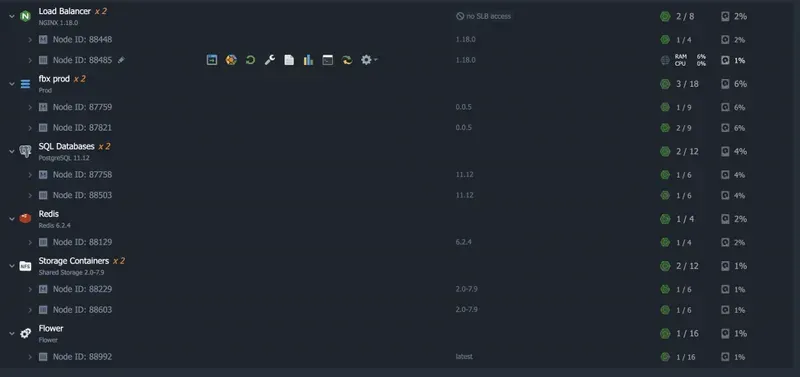
He created two environments: one for staging and one for production. He could continue using Docker Hub to deploy his images. Some adjustments were needed for the Celery/Beat/Task module, which encountered RAM issues. The platform's horizontal and vertical scaling features made it easy to solve this problem.
The concrete financial impact
The most striking result? Jefferson pays a fraction of his former bill for his production environment, with no active users. That's very affordable compared to what he was spending each month on AWS. For an early-stage startup, this difference is significant. It's budget freed up for product development, marketing or simply extending your runway.
This usage-based billing model is one of the key advantages of hosting with Hidora. You only pay for what you actually consume, which is particularly well-suited to startups whose load varies significantly.
Cost comparison over 12 months
To put this in perspective, the annual hosting cost comparison looks like this:
- AWS: a substantial monthly bill that added up to a heavy annual cost for an application with zero users
- Hidora: a small monthly cost, only a fraction of that over the year for the same application
That yearly difference may seem modest in absolute terms, but for a bootstrapped startup, it represents budget that can fund a marketing campaign, a user research sprint or several months of a SaaS tool subscription. More importantly, as the application grows and traffic increases, the gap widens further because Hidora's pay-per-use model scales proportionally to actual consumption rather than to provisioned capacity.
Future plans
Jefferson has several plans for Functional Box going forward:
- Subscription system. Back-end development continues to enable professionals to sell their services through the platform.
- New front-end. Migration to Vue.js is underway, with new REST endpoints.
- Demo environments. Hidora's cloning feature will make it easy to create demonstration servers.
- Kubernetes. Jefferson is exploring Kubernetes capabilities on Hidora for more robust infrastructure.
- CI/CD. Automating deployment after publishing images to Docker Hub remains a priority goal.
Cloud challenges specific to startups
Jefferson's experience highlights a structural problem many European startups face: the choice of cloud infrastructure is often driven by the provider's reputation rather than by how well it fits actual needs. Hyperscalers like AWS, Azure or GCP are designed for enterprises at scale. Their pricing models, configuration complexity and the sheer number of services they offer are calibrated for teams with dedicated DevOps resources.
For a pre-revenue or early-stage startup, this complexity translates into hidden costs: time spent understanding billing, hours invested in configuring services you don't yet need, and the risk of overprovisioning out of caution. Jefferson estimates he lost the equivalent of 2 months of budget on unnecessary hosting on AWS before migrating.
The Swiss market offers relevant alternatives for startups. A local hosting provider with a pay-per-use billing model, accessible human support and infrastructure compliant with Swiss data protection law allows you to start lean, scale progressively and focus on your product rather than your infrastructure.
The data sovereignty advantage for Swiss startups
One aspect that Jefferson initially considered secondary but grew to appreciate is data sovereignty. As Functional Box handles personal health and fitness data, hosting in Switzerland under Swiss data protection law provides a trust signal that matters to users and potential investors alike.
Swiss startups targeting the health, finance or education sectors will increasingly find that data location is not just a regulatory checkbox but a competitive differentiator. End users are becoming more aware of where their data resides, and enterprise clients (gyms, fitness chains, corporate wellness programs) often include data residency requirements in their procurement criteria. By hosting on Hidora from the start, Jefferson avoided a future migration that would have been both costly and disruptive.
A practical recommendation for early-stage founders
If Jefferson had to start over, his recommendation is clear: begin with a managed platform that charges based on actual consumption and invest the savings directly into product development. Concretely, this means allocating no more than 5% of your pre-seed budget to infrastructure. If your hosting bill exceeds that threshold before you have paying users, you are overprovisioning. Run a minimal staging environment for development and a lean production setup. Avoid multi-region deployments, complex CDN configurations and enterprise-grade monitoring until your traffic justifies them. The infrastructure decisions you make at seed stage should be reversible: pick a provider that lets you scale up without re-architecting and scale down without penalty when an experiment does not work out.
Takeaways for startup founders
Jefferson's experience offers several valuable lessons for entrepreneurs choosing their hosting solution:
- Don't follow trends blindly. AWS is excellent, but it's not necessarily the best choice for a pre-revenue startup.
- Watch your costs from day one. Hosting that's too expensive in the early stages can significantly shorten your runway.
- Favour simplicity. A managed platform lets you focus on your product rather than infrastructure.
- Consider local providers. Human support that's responsive and in your timezone makes a real difference.
- Think about data residency early. Choosing a Swiss host from the beginning avoids costly migrations later when clients or regulations demand it.
At Hidora, we regularly support startups with their hosting needs. Whether it's a migration from a hyperscaler or a first deployment, our consulting team is here to help you start on the right foot.

CEO & Co-founder
Founder of Hidora, passionate about cloud-native and Swiss digital sovereignty. 15+ years in the cloud ecosystem.